0 com


Final Thoughts....


With reservations of taking this course in the beginning, I am really happy that I did not drop out of it after the first class. Although the course load proved to be copious, it was necessary in order to fully master the concept of visual rhetoric. Since the first class up until today, I have drastically seen a difference in the way I look at images. Whether it is an advertisement, a political cartoon, or even a random doodle drawing on the desk I'm sitting at, I have realized that everything has a visual argument pertaining to the image I look at. The blog I have created for the purpose of this class has provided me with a candid outlet for me to voice my opinions and observations based on the thousands of images I come across everyday. The five distinctly different types of images I have blogged about really make you, my fellow readers, aware of how vast the range of images are when it comes to analyzing a visual argument. You may have noticed that I tend to look at images pertaining to fashion, as it is an object of study that truly interests me.


Before I took this class I would have never thought of deconstructing an image as I have learned to do within the past couple months of this class. Now, I can not stop but look at images that intrigue me and begin to wonder the visual argument that is trying to be made. I think this course has been successful as it has given me a new perspective on looking at images and most importantly has given me the tools necessary in maintaining a balanced and unbiased opinion based on images that may pose to controversial.


An image that we discussed about in class about social representations is this daunting photo of Kate Moss and cocaine. I chose this image because this is the photo that depicts how one picture can ruin the career of someone in a heartbeat. For Kate Moss, this tabloid cover cost her working for many designer, photographers, and ultimately lost her lucrative contracts with major fashion houses as no one wants to hire someone who is visually seen snorting lines of cocaine. This photo really intrigued me and I chose it as my last photo of discussion on my blog because it shows how fast someone's career can change. How one slip up, especially when in the public eye, can cost you your life. Kate Moss has definitely been able to make a name for herself again, but this image will haunt her for the rest of her life.


My experiences while blogging have been somewhat a journey of discovery. Each time I blog about a certain image I stumble upon a different outlook when looking at a photo. For those of you who do read my blog, I hope it has inspired you to do the same. This won't be the last you hear of me....
0 com


Wait, Weight?

Political cartoons have a way of over exaggerating current events. They usually act as a comic relief to issues that affect the general public. In Mike Keefe’s political cartoon outlining the weight issues and eating disorders accompanied through the fashion industry, he takes the stereotype a bit too far.


The fashion industry is known for creating a standard of beauty for men and women to live up to. However, what is often disregarded are the rules and regulations of being a professional modeling industry. Today, modeling agencies around the world must maintain and adhere to codes of weight and body sizes to ensure that no model works unless they are perfectly healthy.


Keefe’s cartoon illustrates a visual rhetoric of the deathly effects of being a fashion model. The basis of the cartoon is set backstage at a fashion show, where three bathrooms are. The men and women bathrooms depict average people, whereas the models’ bathroom represents an emaciated woman. The tags that were presented under the cartoon on the website were of “bulimia, and anorexia” to further reinforce this depiction.


Although the cartoon pokes fun at the eating habits, or lack of, for fashion models, it in essence stamps a bad representation on what is supposed to be a beautiful career. The cartoon is meant to portray all models as thin people with eating disorders, a subject that is very sensitive to talk about in the first place.


Furthermore, Keefe distinguishes models as a different race, different from men and women. The segregated bathroom thus acts as a place where models can binge and throw up food to make them skinny.


Keefe also uses juxtaposition in this cartoon by positioning the overweight janitor in front of the models’ bathroom comparing the average American to the model. This cartoon seems to effectively show the stigma of the model, but perhaps would offend many who are in the industry.

0 com


Dots, Dots, and More Dots

Art has the ability to make the viewer's mind wander and let’s them escape the boundaries of reality. Contemporary art is such a subjective form of practicing art because it makes the viewer question its purpose and ultimately its ability to be sanctioned as art. The artist, therefore purposely creates a visual rhetoric for their audience in the hopes of persuading them into understanding a concept of life in a different way.


One of the most vivid forms of visual rhetoric performed through art is through the installation. The installation allows the viewer to be engaged with the piece of art instead of just standing in front of a painting. The installation makes the viewer interact and explore the boundaries of the parameters of the artist’s work in the hopes of conveying a relatable message.


Source

In the work of Japanese avant-garde artist and sculptor, Yayoi Kusama, one is able to escape the boundaries of reality and enter into the mind of the artist. Kusama’s Dots Obsession/Love Forever, 2000, was an installation piece that manipulated the minds of the viewers. The installation consisted of 11 oversized, giant, balloons in a white room covered in hundreds of vinyl dots shaped and coloured differently. The visual argument made here has a lot to do with Kusama’s health conditions as the dots represented what Kusama saw through her eyes on a daily basis.


The visual argument made here is simple, to disassociate ourselves from the realties and technologies of the everyday world and enter a fantastical world where there are no limits. Kusama’s installation allows the boundaries of our lives to be destroyed. The exhibit allows one, just for a few minutes, to feel free and powerless. The oversized balloons play with the notion of size and how something that is so mundane in real life is so overpowering in this form. Furthermore, the explosion of dots and colours obliterates our senses and makes us oblivious to the surroundings around us, as everything looks the same. This is a common motif used throughout Kusama’s work.


Analyzed as a whole, installation art is an effective form of visual rhetoric. Its ability to allow the user to engage and make their own assumptions on what the installation truly means is what makes this visual rhetoric so powerful. An artist, such a Kusama, thus has the ability to massage the minds of others by representing their feelings towards society without any words, but rather with art.

0 com


BMV > Jaguar

Advertising is a lucrative business. Advertising corporations pay big dollars for ads that stand out and grab the viewer’s attention. The primary purpose of an advertisement is to sell the product. Thus, advertising companies must always come out with the best ideas and concepts to sell their products.

One of the vital aspects of advertising is competition. An ad must stand out from the thousands to millions of advertisements that are out there. An advertisement that has really stuck out in my perspective was this BMV ad.

The BMV advertisement presented about depicts two cars- a Jaguar and a BMV. The text on the ad is too small to see, but it probably just states the model and make of the car. The strategy used in this ad is to promote how powerful and fast the BMV is.

A Jaguar, which is popular for its famous jaguar hood ornament, in this ad is depicted facing the other way then it is usually faced. The jaguar hood ornament is essentially running away from the BMV.

One thing to notice about the BMV are the headlights. The lights, which are angled upwards kind of resembles an evil eye depicting fear into the Jaguar’s face. The car’s thus are personified where the front of the car represents a face.

The visual rhetoric made in this ad is that the BMV is stronger, faster, and better than Jaguar, one of BMV’s top competitors. This ingenious way of facing the two cars against one another but with just the hood ornament turned the other way, catches the viewer’s attention and makes them consider BMV!

0 com


No Photos Please…


New York City has always been one of my favorite cities around the world. When I was 17 and had the opportunity to take a school field trip to compete in a band competition, there was no question about it; I was going on that trip. The photo I have presented (below), is one of the many faux paparazzi like photos that my friend Emily and I had taken of us by our fans. (And by fans I mean friends that we gave our camera to and made them take photos)


Perhaps the rhetorical argument made in this photo is mocking celebrity candid photos where they are dodging the public eye. That is, in fact, the whole reason why we started to take these photos in the first place. In essence, the photo is a parody on celebrity culture. Our inspiration came from the Olsen Twins, Mary Kate and Ashley Olsen, who are commonly known from shying away from the camera.

When analyzed closer, one can notice how Emily uses an oversized bag to cover her face and has covered her body from head to toe to avoid showing any skin. Her hair furthermore covers her face. Her hand shows how she does not want her face to be shown and ultimately that she is trying to block the camera from catching an unflattering photo from that angle. I however wore oversized sunglasses, another disguise trend that the Olsen’s are known for, to cover a large portion of my face. I also have an oversized clutch and a hoodie to help cover as much of my body as possible.


So the overall question is, is this photo successful in creating a visual argument based on celebrity culture? I would say so. Out body language and techniques used to hide from the camera work. When looking at both photos together, it can be deduced that these tricks of disguise really do work.

0 com


The All American Superstar

With a name that rolls off the tongue, it’s hard not to know who this 21-year old singing sensation is. Taylor Swift is sometimes known as America’s Sweetheart with the girl next-door appearance. With Grammy wins, a humble spot in the country music community, and even a celebrity rivalry with one of Hip Hop’s biggest names (Kanye West), Taylor Swift is fearlessly taking over the music industry.


Her look is rather wholesome. With her perfect blonde curls and white dress after white dress, Swift certainly has a predictable appearance. The photo above is just one of many photo shoots where she is depicted looking innocent wearing white and acting angelic. Perhaps that is what the music executives of her record label are trying to push for her. A look that is memorable and static in the viewers mind creates a solid fan base that can only grow with further success.


The music industry today represents women in a sexy, sultry, and to some extent an offensive manner. The Pussycat Dolls, Rihanna, and even Disney starlet Miley Cyrus, have all been transformed from young powerful female role models into sex symbols.


The photo above argues how Miss Swift isn’t like one of these dirty girls. She’s pure and relatable to the everyday girl. Her make up is minimal and each curled blonde lock simply bounces in the beautiful sunny weather. Her perfect smile furthermore makes Swift friendly and approachable. However, how much longer will this image last? For all we know, Taylor could crack under the pressure of the music industry anytime where she’ll come to a point in her career where she “should’ve said no.”


Regardless, Swift and Swift's management team have successfully marketed her into someone who people want to be or aspire to be like. Her music paired with her wholesome image has proven to bring Swift success. Let’s just hope she knows how to renew her look in a classic and mature fashion.

0 com


The Infamous Armadillo
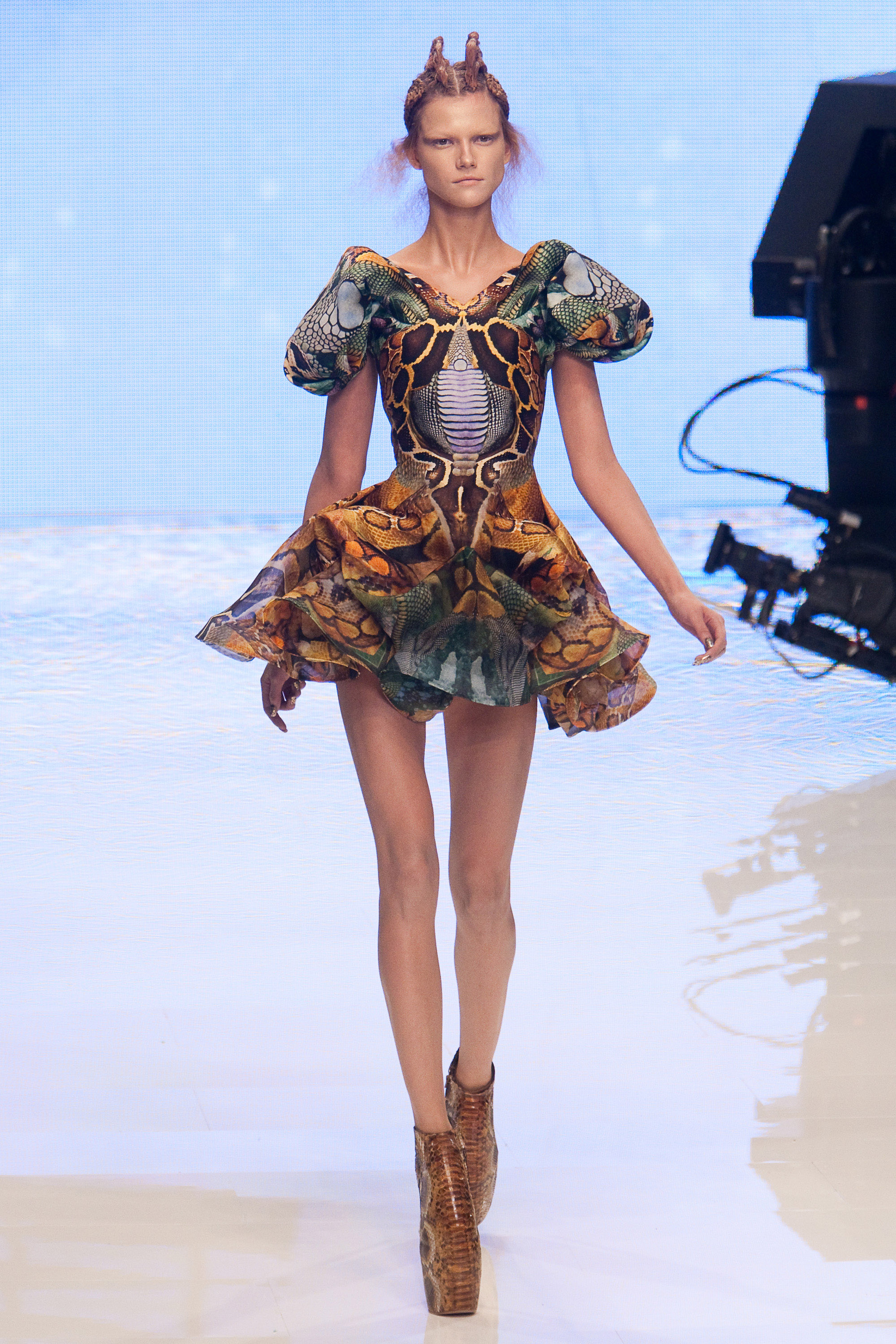
Fashion is a subjective art form. Every editor, designer, and spectator hold a different view on what is in style and fashionable. A fashion show is an outlet, which allows a designer to portray their vision on politics, trends, or even environmental issues through clothing. The photo taken from the late Alexander McQueen's spring/summer 2010 collection creates an argument of environmental change and harmony with nature.
The collection, titled Plato's Atlantis, portrays 45 looks, which construct a physical evolution of the creatures on Earth. The show collectively makes the audience aware of how sacred and beautiful life was before the introduction of modern day technologies. The models, dressed and presented in an animalistic formation opens the audiences eyes to the primitive beauty of a world free of commercialization. The photo above is just one of the 45 looks that McQueen produced for the show. The dress, with its unique tortoise like print and structured body presents a message of durability and strength, just like a tortoise itself. The infamous armadillo shoes stretch the idea of strength further. With feet that can dig and survive through anything, the McQueen woman is anything but docile and weak. Finally, the hair, which is corn-rowed and teased presents a warrior element to the look. The McQueen girl, resembles those of the Na'vi clan, presented in James Cameron's Avatar. The long, blue skinned creatures evoke an everlasting message of strength and stability in their own world, just as the McQueen girl does in this show. McQueen's overall message leaves a lasting impression on the viewer's input on contemporary media and society as a whole, where the characteristics of a strong independent woman come before modern day technologies.

The effectiveness shows through the after effect. Known as McQueen's final show before his tragic death, Plato's Atlantis has already become an iconic show more than just an art form, but rather as a realization of the world we have created, and his vision of hope and beauty in the world we will create in the future.

To fully grasp the message watch the show in its entirety.